By 2035, AI data centres may use more than 30% of Malaysia's electricity. The interesting part is who sends them the bill.
Oracle, AWS, Microsoft and Google have all come.
Johor gained partly because Singapore paused new large data centres from 2019 to 2022, and the demand spilled across the causeway.
The bottleneck isn't chips. It's power.
One 600 MW park uses as much power as 730,000 to 1,460,000 homes.
Every question you ask a chatbot runs on a room of GPUs burning electricity.
YTL's Green Data Centre Park in Kulai, Johor is planned for 600 MW. Run all day, all year, that is about 5.26 billion units (kWh) a year, and it can't switch off.
Big users don't get cheaper water
Data centres in Johor pay about 1.8 times the household water rate.
Cooling a large data centre can take tens of millions of litres of water a day. Johor started tightening approvals for water-heavy projects in late 2025.
Some Johor data centres now use treated wastewater instead of tap water. That changes which water they draw, not how much evaporates in cooling.
AI jumps the queue
The race is no longer only about who builds the best AI. It's also about who still has power and water.
In February 2026, Prime Minister Anwar Ibrahim told Parliament that approvals for new non-AI data centres are being limited, while AI projects still get priority.
Who gets power and water, and who waits, is now a government decision.
The supply chain runs two ways
Up the chain decides who grows. Down the chain decides who gets stuck.
Most people only look up (that half is in Malaysia's AI chip stocks).
Whoever wins the AI race, the power and water bills still get paid, to companies like Tenaga and Ranhill (Ranhill SAJ supplies Johor's water). Steady demand isn't the same as a healthy company, though: their scores are below, and they differ a lot.
Stocks in this article
Score out of 100:80+ Strong40-79 Okay0-39 Weak
Power, grid and water
Data-centre builders
FAQ
S&P Global Ratings expects data centres to use more than 30% of Malaysia's electricity demand by 2035.
143 data-centre projects, about RM144.4 billion of investment, approved from 2021 to mid-2025. Johor is expected to hold about 60% of national capacity by 2030.
Yes. Johor's data-centre water tariff is RM5.33 per cubic metre, about 1.8 times the RM2.89 average household rate (effective August 2025).
In February 2026 the Prime Minister told Parliament that approvals for new non-AI data centres are being limited because of pressure on power and water, while AI projects still get priority.
On this site's AI list, the power and utilities group includes Tenaga, YTL Power and Ranhill, among others; data-centre builders include Sunway Construction, Gamuda, IJM and WCT. Each has its own fundamentals score; a supplier to a growing industry isn't automatically a healthy company.
Next read
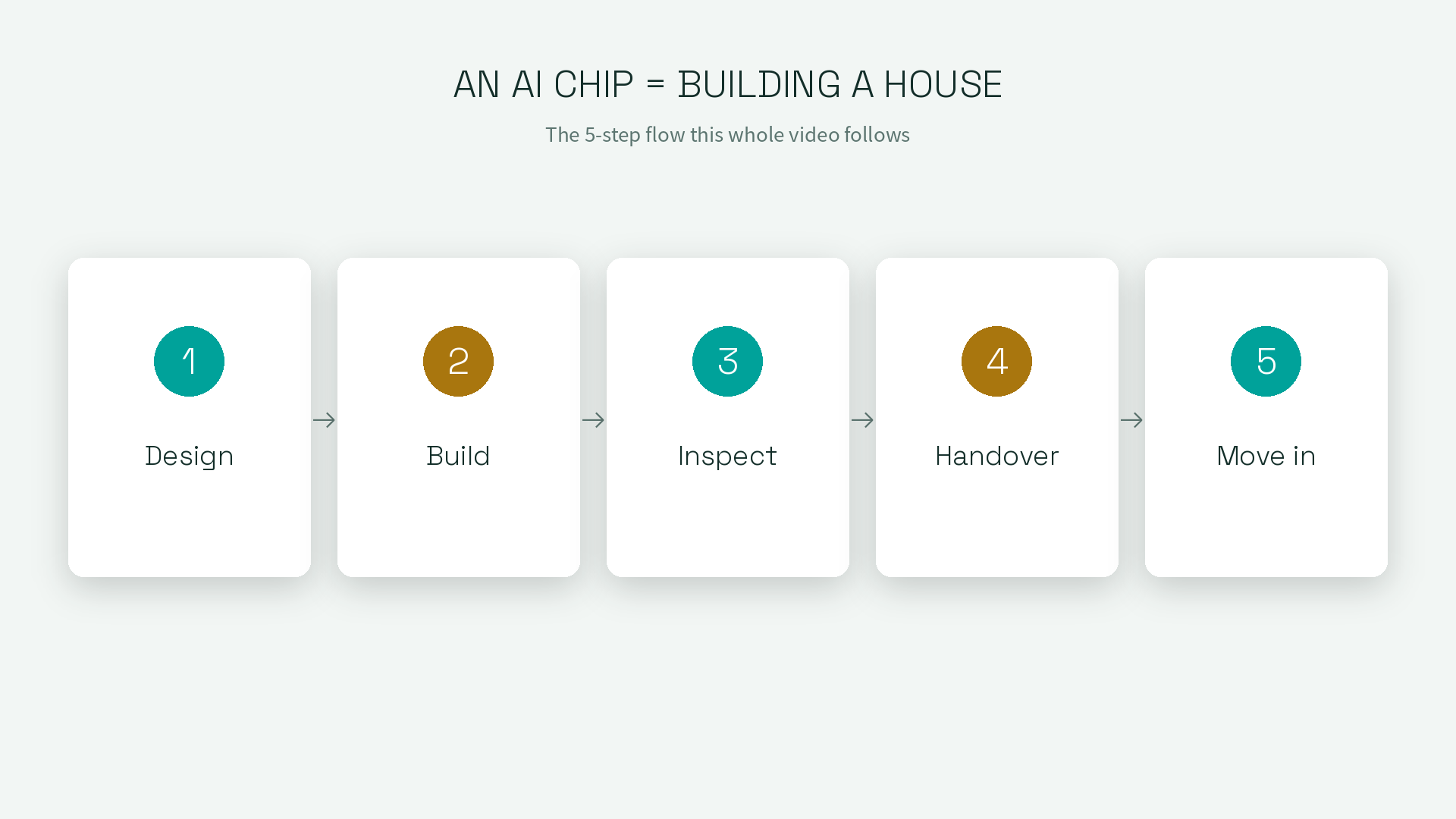
Malaysia's AI Chip Stocks, Explained With a House
Design, build, inspect, package, run: 5 jobs, and which ones Bursa actually has.
Sources (7)
- AMRO (projects, investment, Johor share)
- S&P Global Ratings, 2026 (2035 power share)
- Tech Stories (600 MW park)
- Business Today, 19 Sep 2026 (Johor water tariff)
- Bloomberg, 26 Nov 2025 (Johor approvals)
- TechRepublic (Singapore pause)
- News reports of the February 2026 parliamentary statement
Worked out from these: kWh = 600 MW × 24 h × 365 days; homes at 300 to 600 kWh a month (TNB tariff block bounds).
Educational content, not investment advice. Do your own research, or speak to a licensed financial adviser, before investing. See About for how this site works.