The Priciest Stock on Bursa Isn't the Biggest Company
Published 20 Aug 2026 · Market data as of 10 Aug 2026
Bursa Malaysia has 1,130 listed companies. Most investors could probably name ten of them. This article is a quick tour of how the whole market is actually put together — not which stocks to buy, just what the market looks like from above.
Three things surprise most people who look at this for the first time: the most expensive stock per share isn't the biggest company, the second-largest industry by value is plantations, and Bursa runs on a completely different logic than the US market. Here's why.
1,130 companies, three markets
Every company on Bursa sits in one of three markets — Main (established, larger companies), ACE (earlier-stage and more volatile), and LEAP (SME fundraising, closed to retail investors):
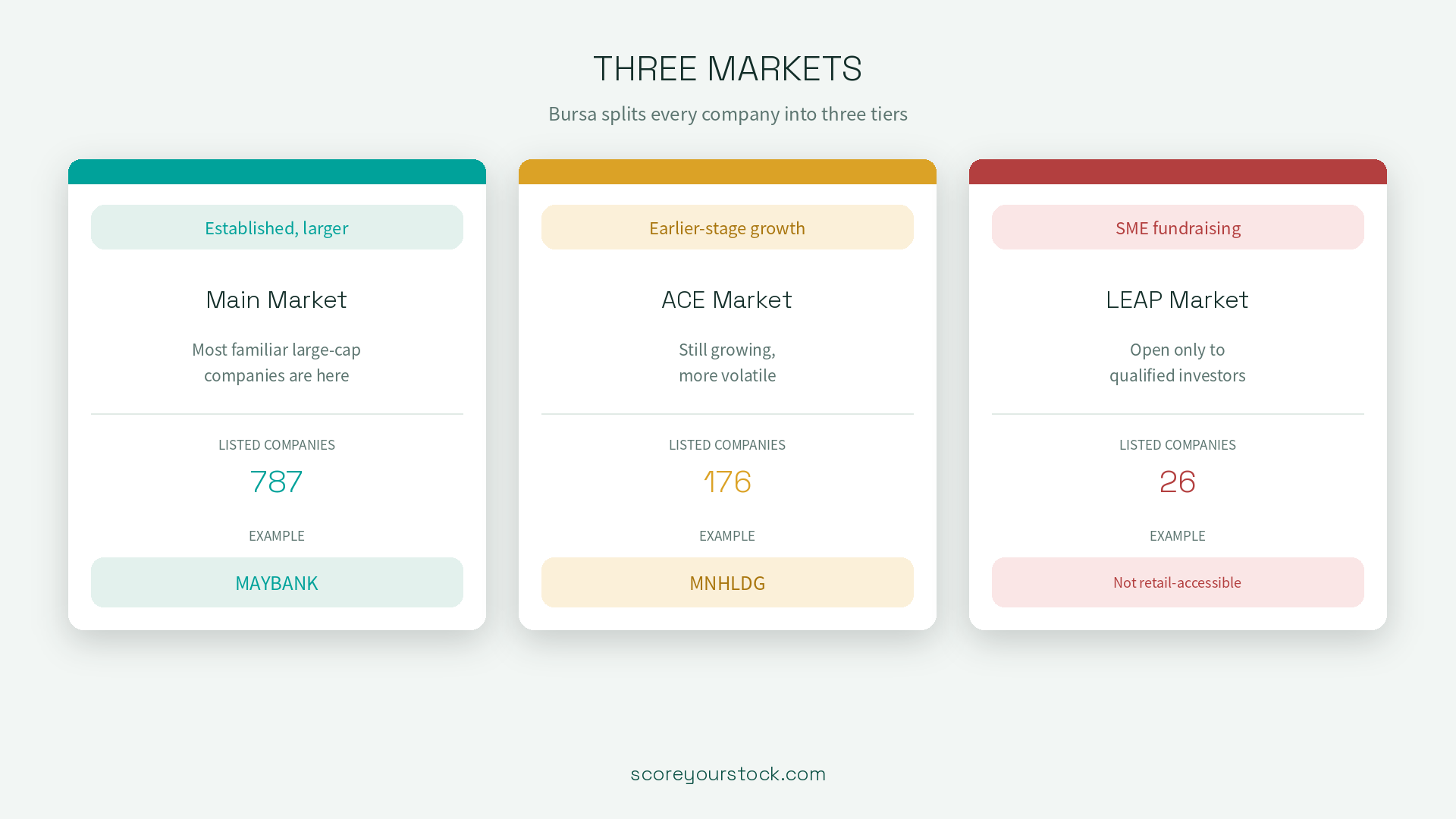
1,130 sounds like a lot to keep track of. It is — but as the next few sections show, a small number of those companies account for most of the market's value.
Stock price and company size are not the same thing
A common assumption: the higher a stock's share price, the bigger (or better) the company. Two real Bursa stocks make the opposite case.
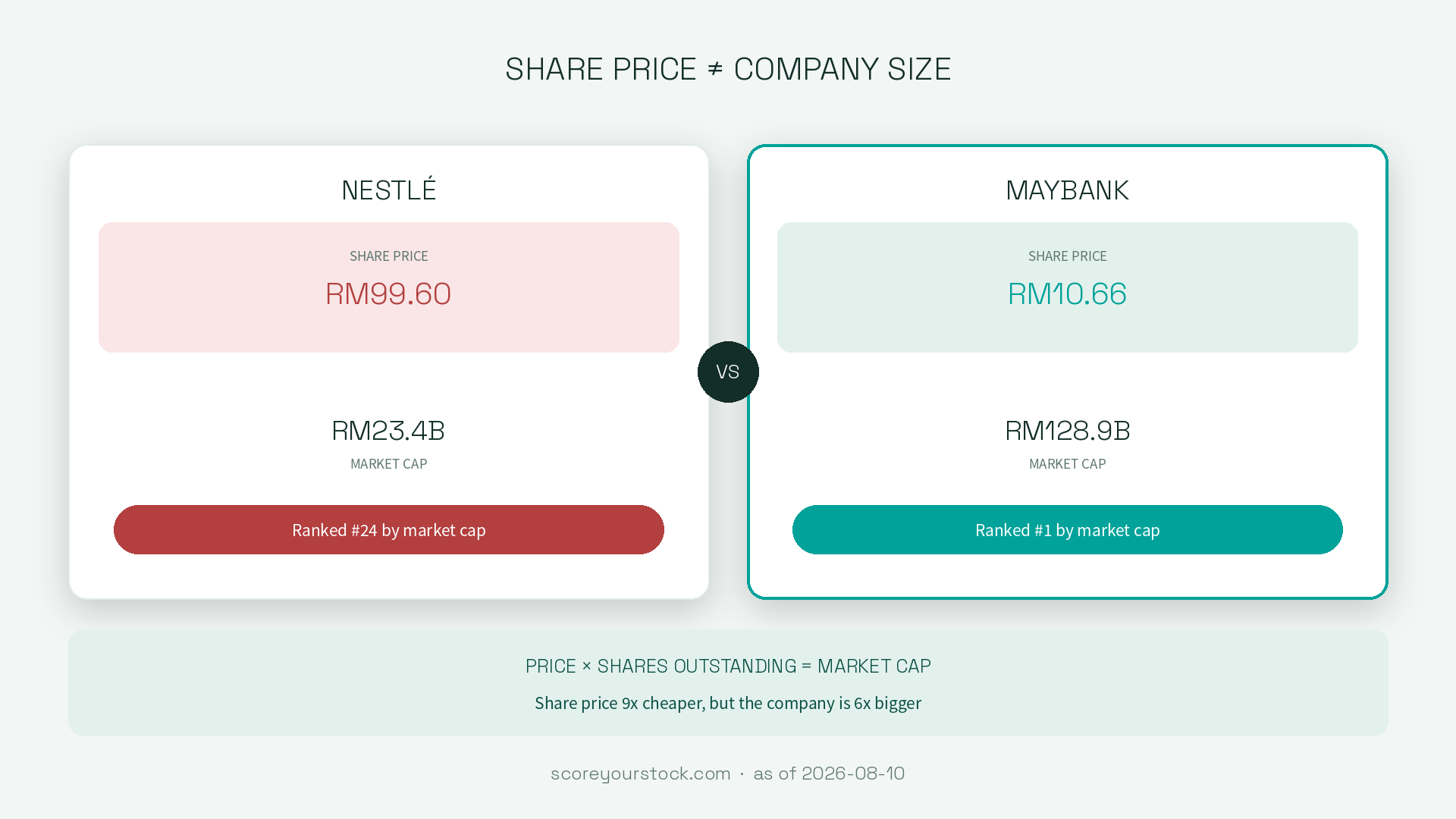
What actually measures a company's size is market capitalisation ("market cap"): share price multiplied by the number of shares in issue.
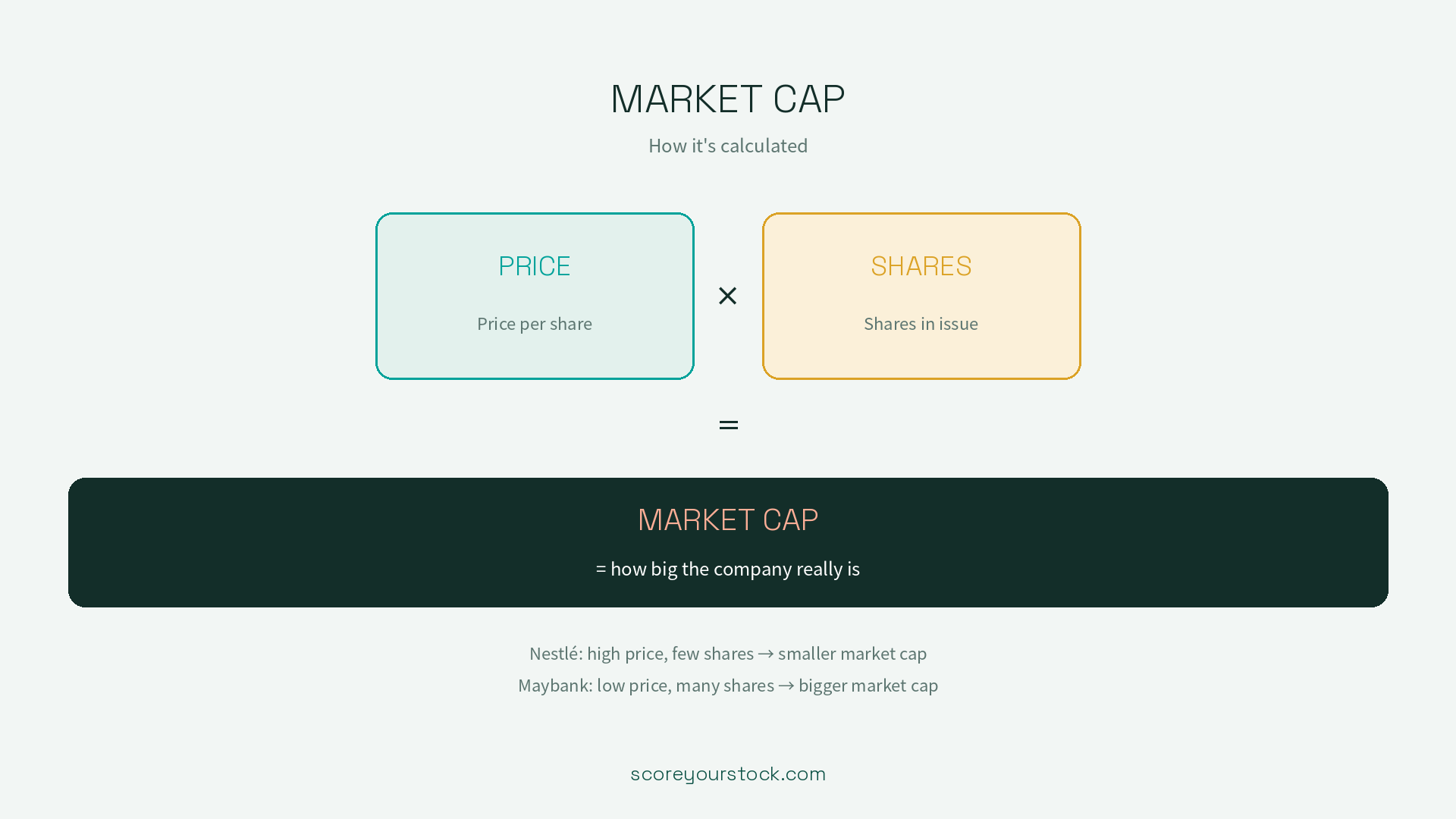
Once that clicks, a lot of market-cap-based rankings — including the ones on this site — make more sense: they're sorted by company size, not by how expensive one share looks.
The KLCI only tracks the top 30
The index most people mean when they say "the Malaysian market went up" is the FTSE Bursa Malaysia KLCI — usually just "KLCI." FTSE (pronounced "Footsie") is a UK index-compiling firm; the KLCI is jointly maintained by FTSE and Bursa Malaysia. Think of Bursa as a school with 1,130 students, and the KLCI as a report card that only tracks the 30 highest-achieving ones — the 30 largest companies by market cap:
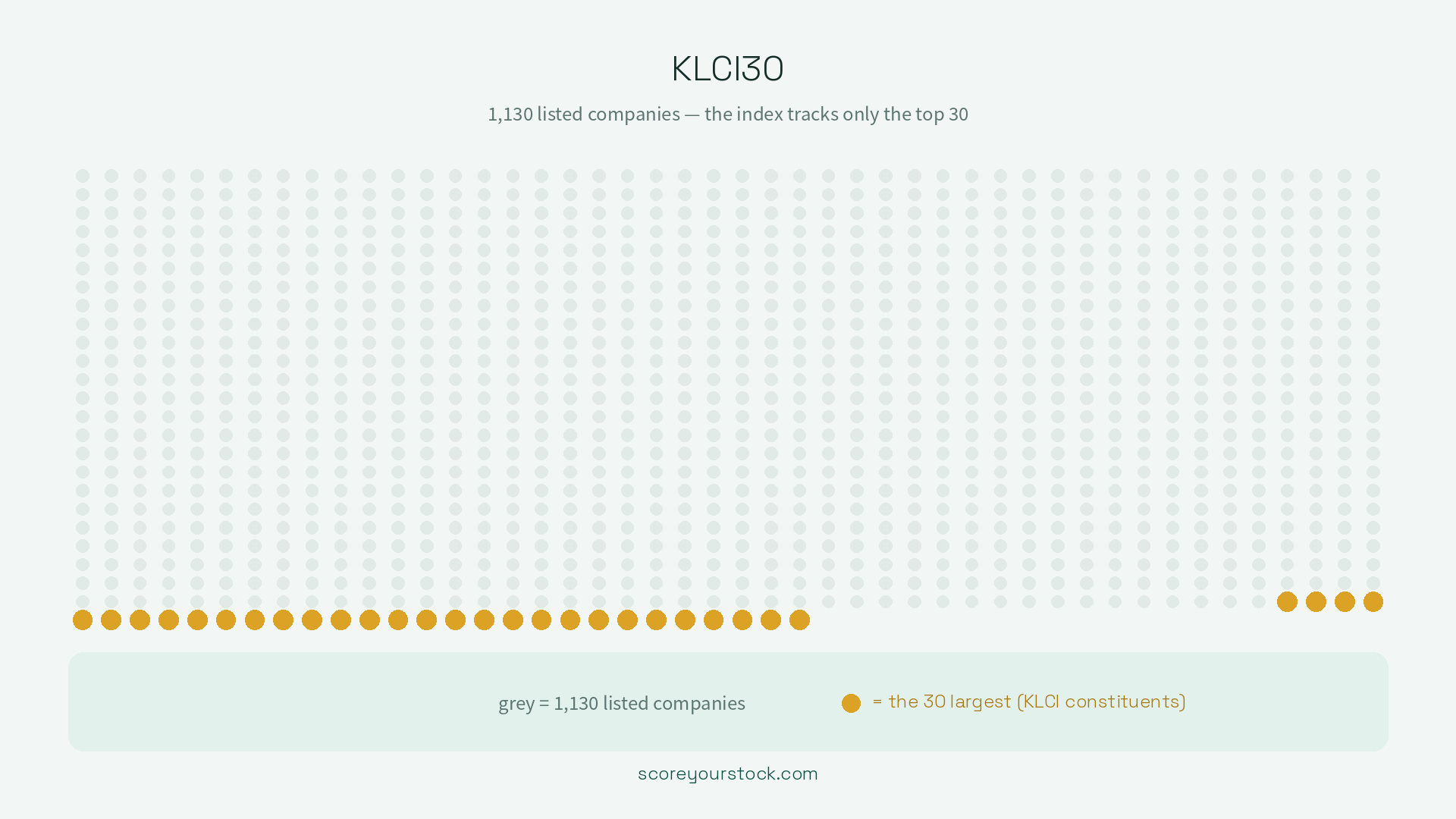
The KLCI's five largest constituents are Maybank, Public Bank, CIMB, Tenaga Nasional, and IHH Healthcare. Three of the five are banks. So when the KLCI is reported as "up," it can mean the whole market is doing well — or it can just mean a few large banks had a good day while the stock you actually hold barely moved.
Where the money actually sits
Bursa officially groups companies into 13 sectors, further split into 44 sub-sectors — the finer cut is what actually groups similar businesses together (a 13-sector "Industrial Products" bucket, for instance, lumps together hundreds of unrelated businesses). Adding up market cap by sub-sector gives a clearer picture of where the money in this market really sits:
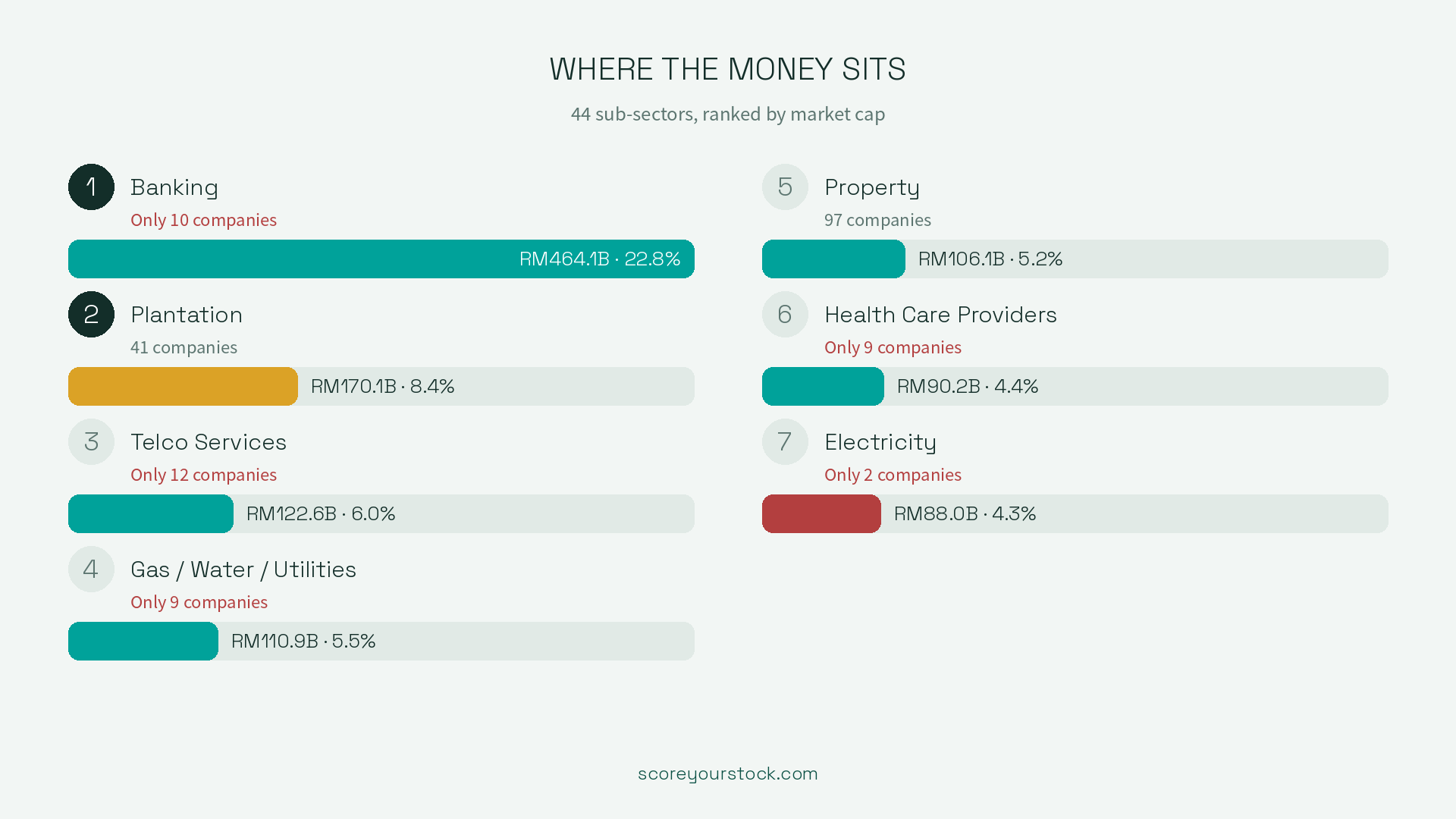
One in ten of Bursa's 44 sub-sector groupings — Banking — holds nearly a quarter of the entire market's value. And one comparison makes the Plantation number land: the entire Technology sub-sector, 113 separate companies, is worth less combined than Plantation's 41.
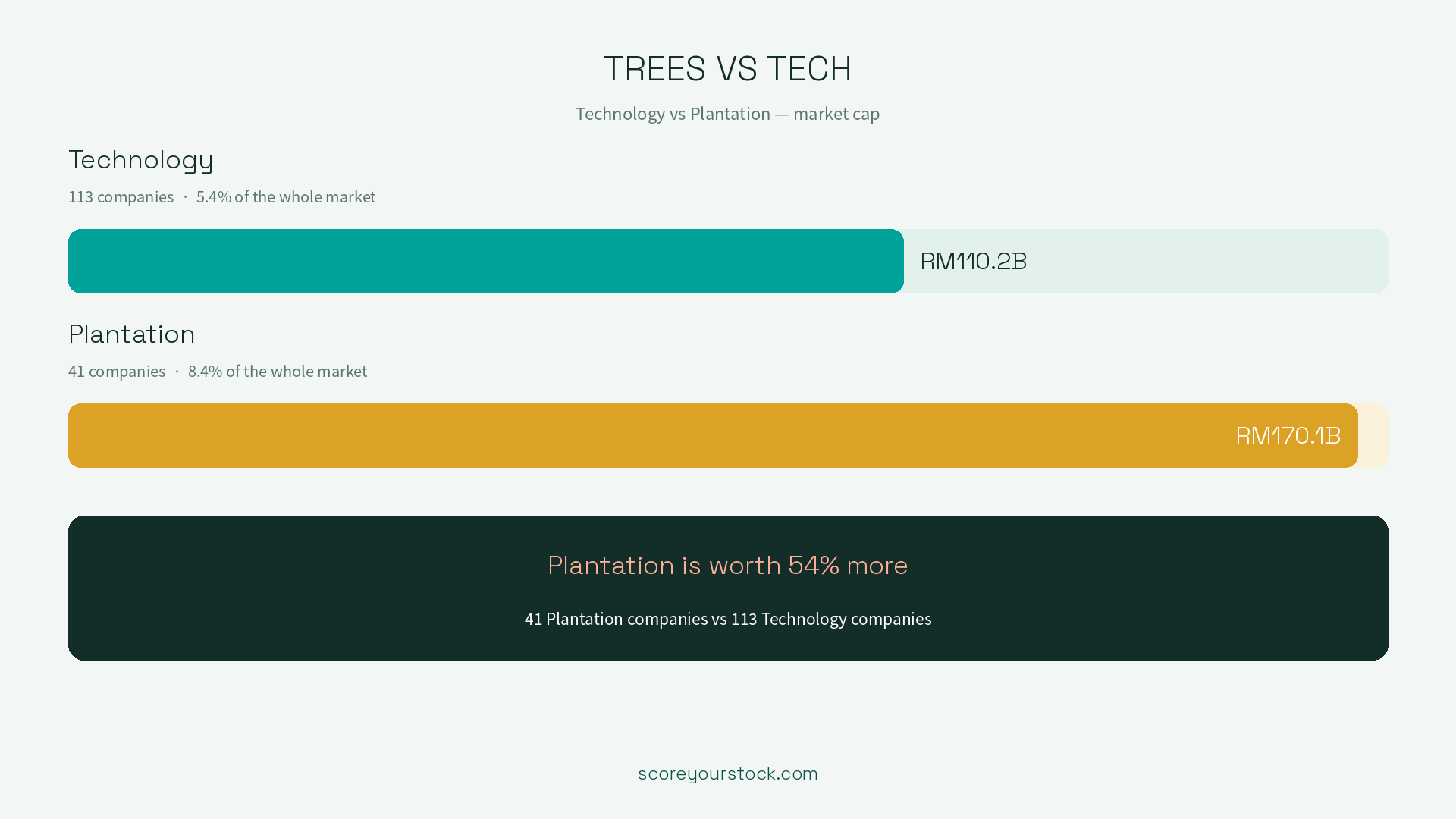
On Bursa, growing trees is currently worth more than building tech companies. The pattern across all of this: Bursa's value isn't spread evenly across 1,130 companies — it's concentrated in a small number of sub-sectors, which is also why a downturn in one of them (banking, say) can drag the whole market lower even though most listed companies had nothing to do with it.
Why Bursa probably won't ever look like Wall Street
This also answers a question a lot of newer investors ask: why doesn't Bursa have its own Apple or Nvidia? Because the two economies are built differently — the US market's largest companies sell a product; Malaysia's largest, banks, profit from the entire economy passing through them:
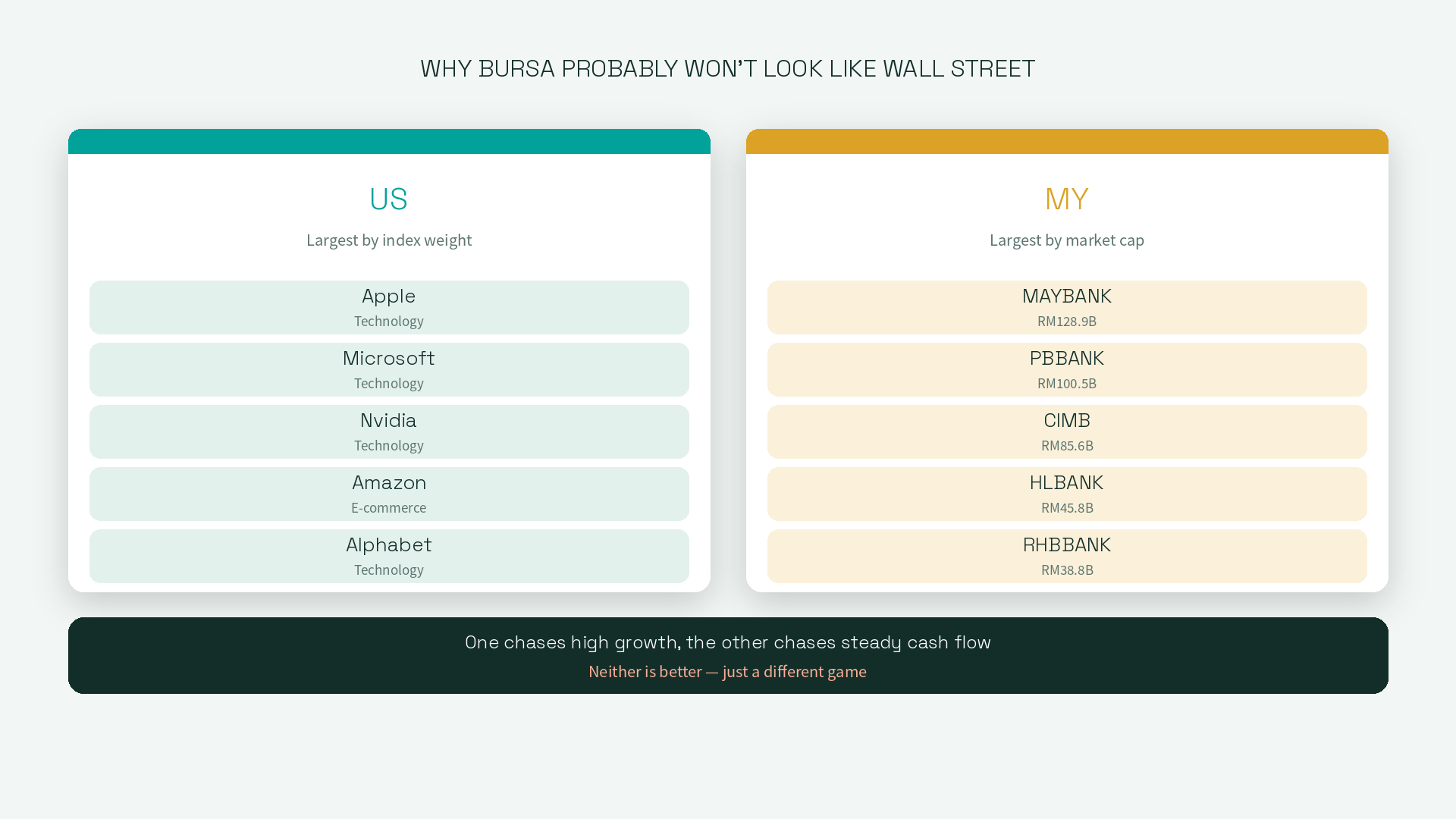
A bank rarely grows the fastest, but it tends to be the steadiest earner in the system — and that structural difference shapes investor behaviour too:
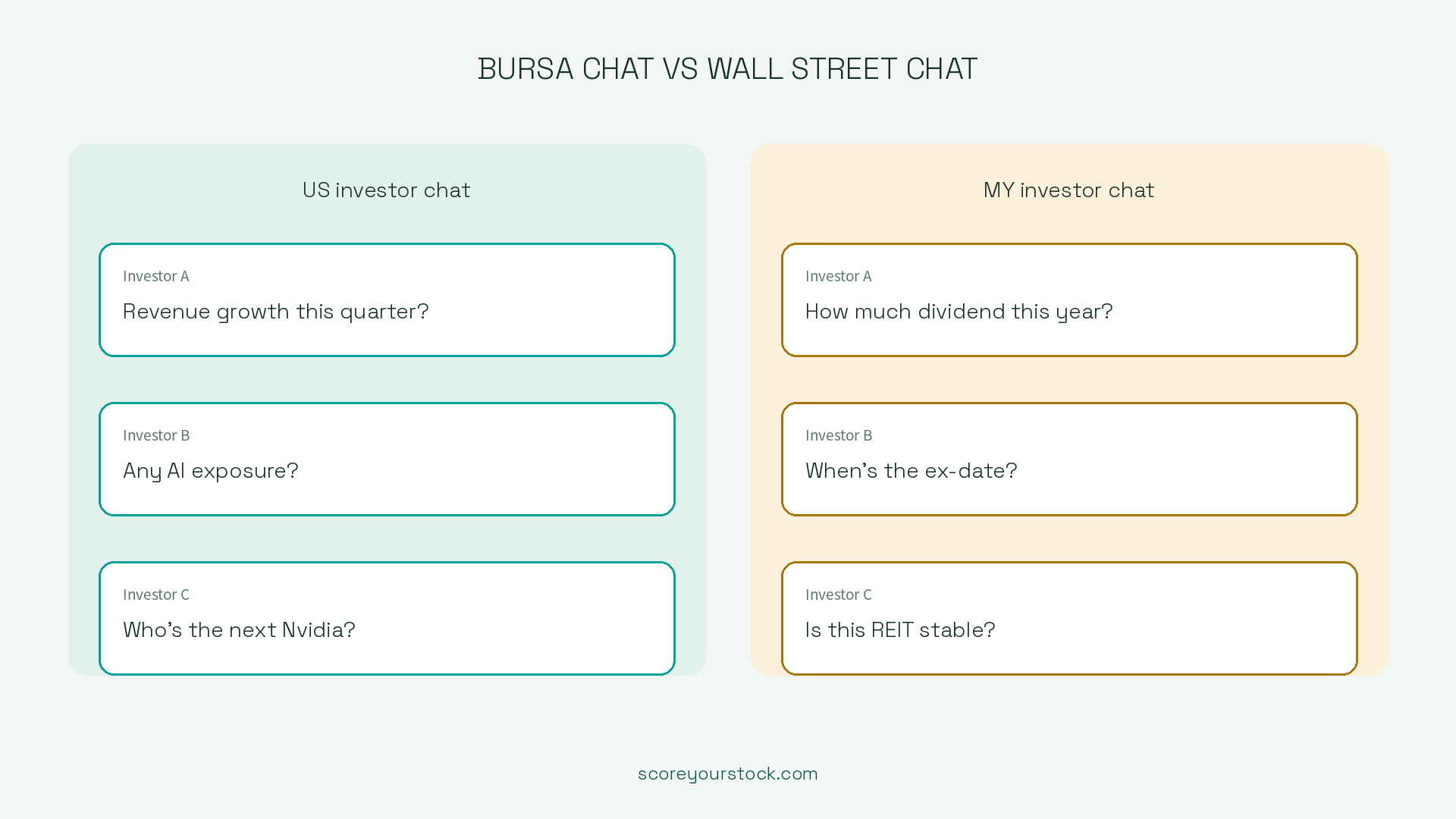
Most Bursa investors aren't holding for share-price doubling — they're holding for a steady, recurring payout. Neither approach is "better." They're just different games, shaped by different markets.
Three things worth remembering
- 1. Share price isn't company size. Market cap (price × shares outstanding) is what actually measures a company's scale.
- 2. Banks are Bursa's real heavyweight. Ten banking stocks hold nearly a quarter of the entire market's value.
- 3. Bursa is built for dividends, not breakneck growth. That's a structural feature of the Malaysian economy, not a flaw.
Once these three things are clear, reading any individual stock — including its price, its sector, and where it sits in the KLCI — gets a lot easier to place in context.
Score Your Stock scores all 1,130 Bursa-listed companies 0–100 on fundamentals, free. Start with the Financial Services sector (home of Bursa's biggest sub-sector, Banking), browse every company by sector, or look up Maybank and Nestlé directly.
This article is educational content, not investment advice — always do your own research, or speak to a licensed financial adviser, before investing. See About for more on how this site works.